We Used AI to Build a Landing Page. Here’s What Happened.

Over the last few weeks, we’ve been testing a question that many companies are asking.
If AI can generate a landing page in minutes, what does that mean for the design process?
Rather than answer that in the abstract, we ran a small experiment on our sister agency’s homepage. Given the same content outline, four designers tested a different AI website builder.
The goal was to see what these tools are actually good at and where they break. And, more importantly, assess whether any of them could meaningfully improve our own processes.
Long story short, AI is useful—but not in the way the hype suggests.
First, a little more context on our experiment:
- While dozens of AI page builders exist, we chose Framer, WIX, Gamma, and Relume to test.
- Designers only had two hours to work with their respective tools.
Here’s what we found:
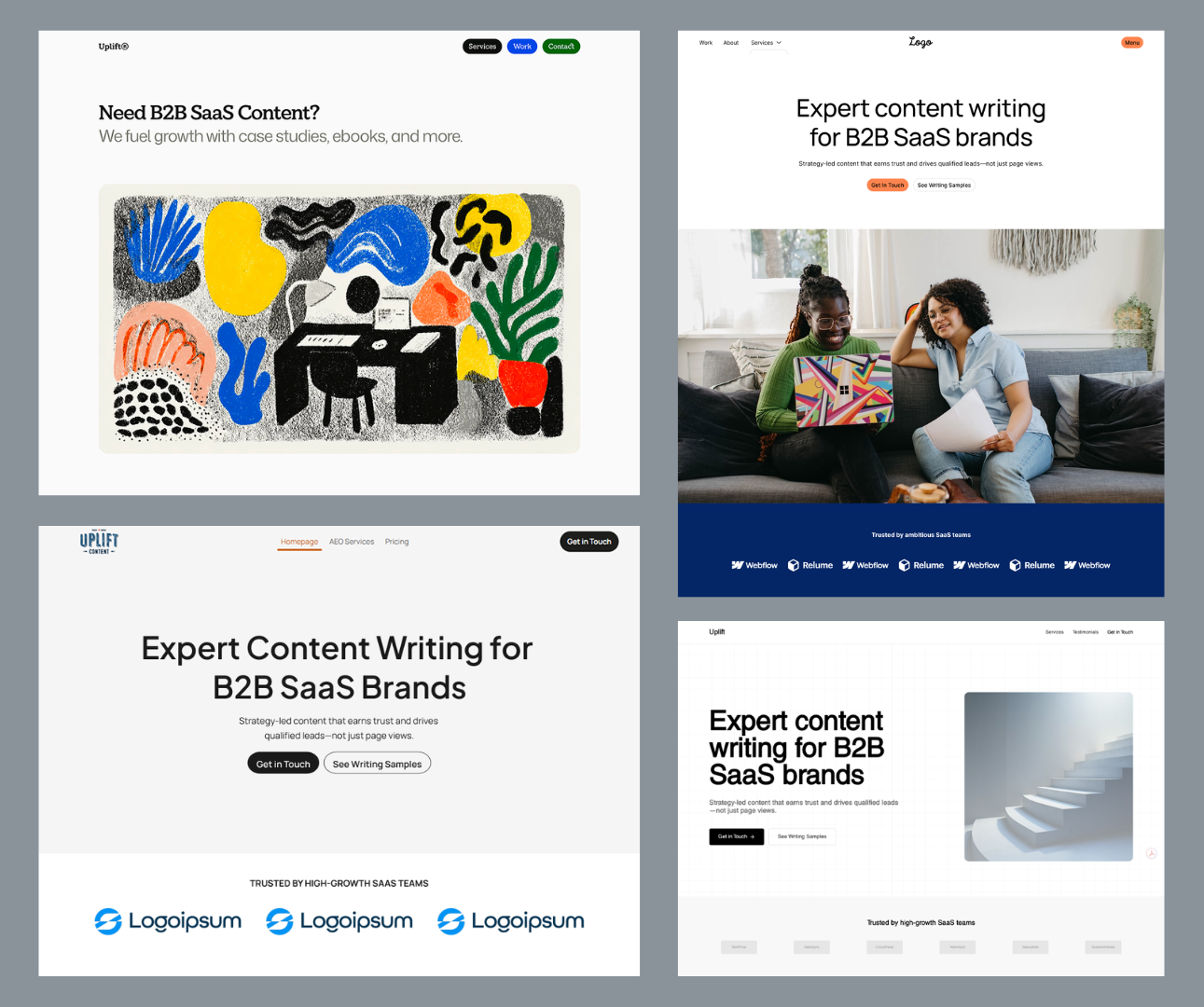
- The extent of AI functionality varies widely between platforms. For example, Framer only accepted an initial text prompt to generate a page—there wasn’t much AI integration otherwise. By comparison, Gamma offered image generation, though its graphics weren’t that impressive. In one case (Relume), the AI overstepped, rewriting copy without being asked.
- The initial page output was hit or miss. The best (Relume) produced a decent starting point complete with a sitemap and wireframes, while the worst (Framer) gave a very basic layout.
- Even the more promising tools had limitations in customization. For instance, it wasn’t easy to make adjustments to the page layout in Gamma or resize text boxes in Relume.
- Across the board, the tools struggled to do the stuff that defines design work: iteration. For example, WIX ignored follow-up prompts to replace images. At one point, it simply removed certain elements instead of swapping them for icons as requested.
Zooming out, the experiment made a few things clear.
First, the AI arms race has led site builders to add AI features without creating much practical value—a sign, I believe, that these companies are panicking to stay relevant. The recent drop in Figma’s stock price is probably part of this alarm.
Secondly, even the best tool had limits. Of the platforms we tested, Relume stood out because it helped produce wireframes, create responsive layouts, and could export into tools our designers already use. But it rewrote copy when we didn’t want it to and prevented easy design tweaks.
No, we didn’t test all of the AI site builders out there, but it’s hard to imagine a platform that wouldn’t still require a designer to shape the final result.
The biggest lesson from our experiment, though, was that the best use of AI in design is not to replace the execution. It’s to change where human energy goes.
If a tool can help us get to a starting point faster, that gives us more room to focus on what can't be automated: judgment and taste. Those human decisions are particularly important when it comes to landing page UX and design, where structure and user behavior impact conversions.
As one designer shared during our experiment postmortem, the speed of AI’s production “can be helpful for very early exploration.” It gives an initial concept to react to, and in doing so, gives us more time to think about positioning and what the page is really trying to communicate.
In other words, AI is most valuable when it acts as a multiplier for strategic thinking. The same principle applies when working to improve landing page conversion rates. Tools can speed up execution, but strategy determines the outcome.
We’re continuing to test tools, especially knowing that not all are created equal. But at this point, we recognize that AI can help create some momentum. What it cannot do is replace creative direction.
This is where the time-based billing model breaks down since it ties price to time instead of value created (a topic better saved for another newsletter). So I’ll leave it at this: the value of design was never in pushing pixels around for as long as possible. It’s in knowing what should be made and why it should look the way it does.
Design tools may be changing, but the need for strategic thinking is becoming more obvious, not less.
A version of this post originally appeared in the Klimt & Design newsletter. Sign up to get similar insights on branding and design delivered to your inbox.
Sign up for our newsletter
Related stories

The First Ask Is Not Always the Real Need
When a project’s needs change, our role is to help connect the dots.

Rebrand vs. Brand Refresh: How to Decide What Your Business Needs
A rebrand isn’t the same as a brand refresh. Both can help your business evolve, but they differ in scope.